HMM-Gated Protein Language Model Embeddings for Bacterial Cultivation Condition Prediction
Gating ESM-2 with curated HMM marker panels to predict cultivation conditions from genome sequence.
Abstract
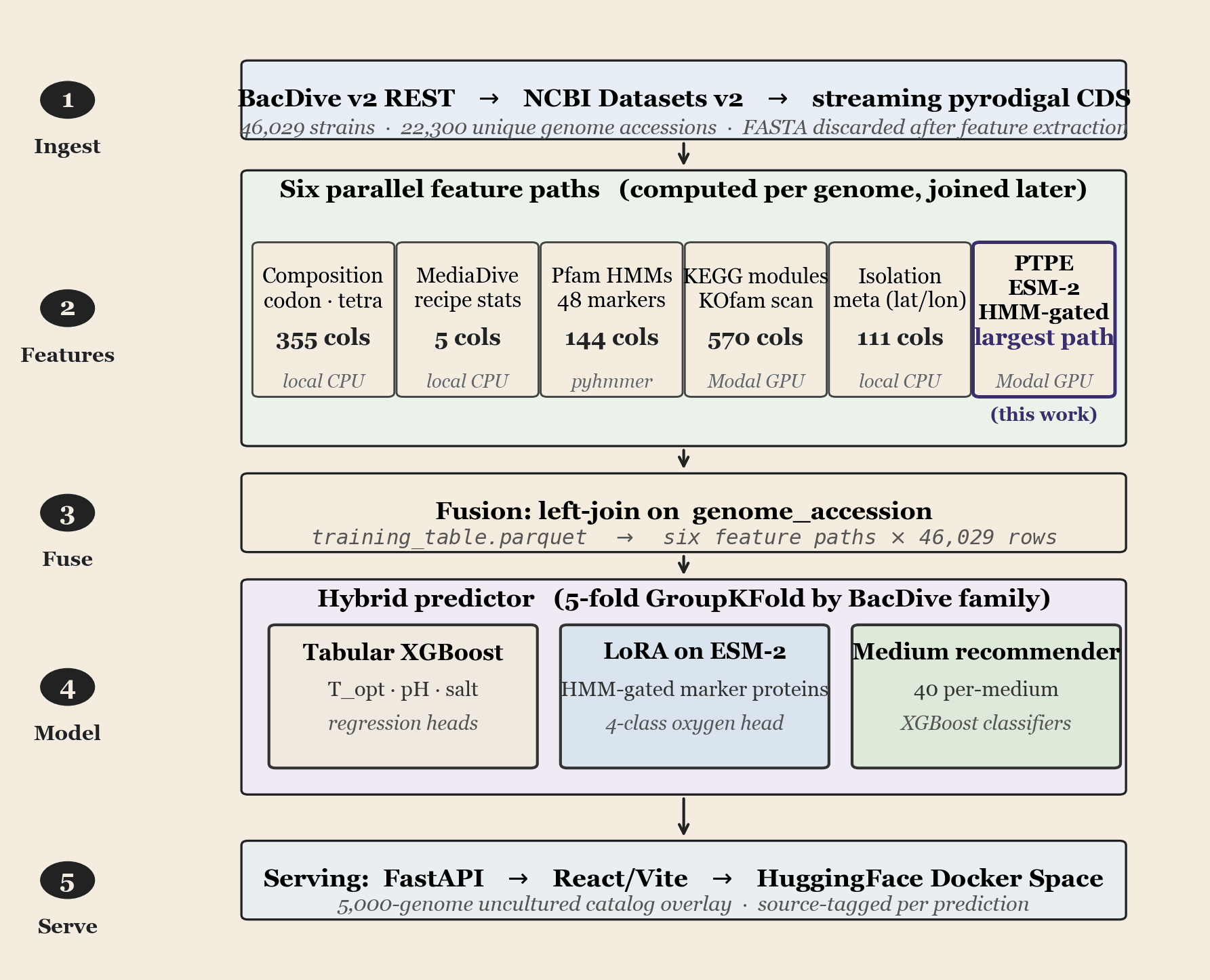
The majority of microbial diversity remains uncultivated, in large part because we do not know what cultivation conditions a given lineage requires. Existing genome-based phenotype predictors operate on a single feature family: protein family inventories, codon usage statistics, or single-trait marker panels, and most binarize continuous phenotypes such as optimum temperature, pH, and salinity into coarse labels. Here we introduce HMM-gated protein language model embeddings (PTPE, phenotype-targeted PLM embeddings): for each genome we run pyhmmer against eight curated phenotype-relevant HMM marker families (oxygen handling, thermotolerance, pH homeostasis, osmotic response, vitamin biosynthesis, nitrogen cycling, carbon utilization, and a "special" category), embed only the matched proteins with a frozen protein language model (ESM-2), and mean-pool within each category to produce a compact per-genome functional fingerprint.
We integrate PTPE with five additional feature paths: amino acid composition, MediaDive recipe metadata, Pfam HMM marker counts, KEGG module fractional completeness (570 modules), and parsed BacDive isolation metadata, for a total of 6,313 features per genome, and train a multi-task XGBoost over 46,029 BacDive strains (22,300 unique genomes) for four cultivation targets (optimum temperature, pH, oxygen requirement, salt tolerance) with five-fold family-grouped cross-validation.
The cultivation bottleneck
Cultivation of microbes from environmental samples is bottlenecked not by sequencing or isolation hardware but by the prior question of which conditions to use: optimum temperature, pH, oxygen tolerance, and salinity must be chosen, typically from broad ranges, before a strain can be enriched in pure culture. For the >99% of bacterial and archaeal lineages that have never been cultivated, 16S placement provides only weak constraints on these conditions. Phylogenetically close strains routinely differ by 10 °C in optimum temperature or several pH units. Direct prediction of cultivation conditions from genome sequence would lower this barrier substantially.
Why protein inventories are too coarse
A common gap across the prior literature is that protein family inventories are coarse. A Pfam hit is binary: "does this genome contain a cytochrome c oxidase?" It collapses the substantial sequence-level variation between different cytochromes: variation that determines whether the organism is microaerophilic, strictly aerobic, or facultative. Protein language models such as ESM-2 are designed to expose precisely this continuous variation, but naive whole-proteome PLM pooling averages ESM-2 across every protein in a genome, drowning the few phenotype-relevant proteins (12 cytochromes) in the ~4,000 housekeeping ones and producing a feature vector that is biologically dilute.
A middle path: HMM-gated PLM embeddings
We propose a middle path: use the HMM as a gate for which proteins to embed. For each genome we run pyhmmer against a curated panel of 48 phenotype-relevant Pfam HMMs grouped into 8 categories, embed only the matched proteins with a frozen ESM-2, and mean-pool within each category. The result is a phenotype-targeted protein language model embedding (PTPE): a compact per-genome functional fingerprint that keeps the specificity of HMM-based feature selection and the continuous functional resolution of PLMs. We integrate PTPE with five additional feature paths and train a multi-task XGBoost on 46,029 BacDive strains with family-grouped cross-validation, the largest BacDive-anchored phenotype prediction corpus published to date (~2× the size of prior work).
Contributions
- PTPE construction. A novel feature type for genome-level phenotype prediction. To our knowledge no prior work in the eight surveyed BacDive-era papers uses HMM-gated PLM mean pooling.
- Multi-source feature fusion at BacDive scale. 46,029 strains × 6,313 features integrating composition, MediaDive, Pfam markers, KEGG modules, isolation metadata, and PTPE, with 5-fold family-grouped CV and the strongest pre-PTPE baseline released as a reproducible comparator.
- An honest empirical evaluation. PTPE adds modest, target-dependent lift on regression targets (1-2.4%) but slightly regresses oxygen F1. We do not overclaim; we characterize where frozen PTPE helps and where it does not.
- A fold-0 LoRA result and deployed hybrid predictor. End-to-end trained ESM-2 adapters improve oxygen classification substantially but do not replace tabular heads for continuous targets, so we deploy a phenotype-specific hybrid and apply it to 5,000 uncultured catalog genomes.
- A GenomeSPOT comparator. We run GenomeSPOT on 5,000 held-out BacDive-derived genomes from the same family-grouped manifest, producing an external condition-trait comparator with no failed genomes.
What the evaluation shows
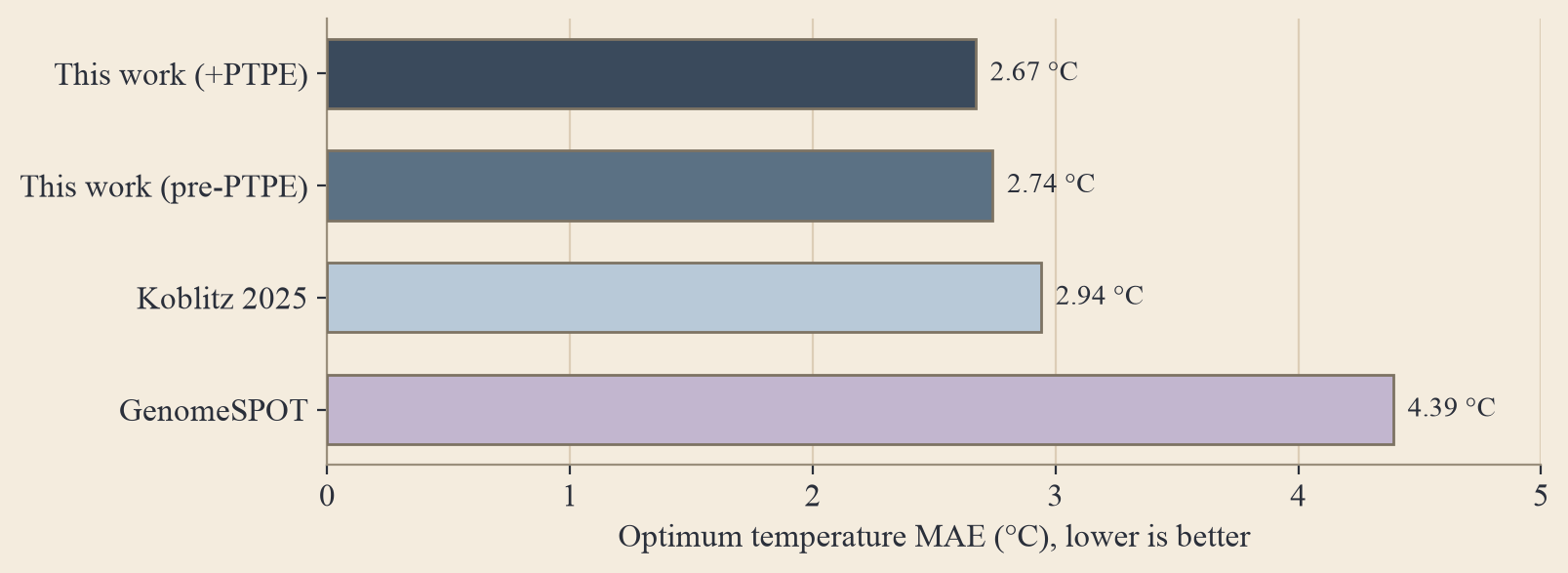
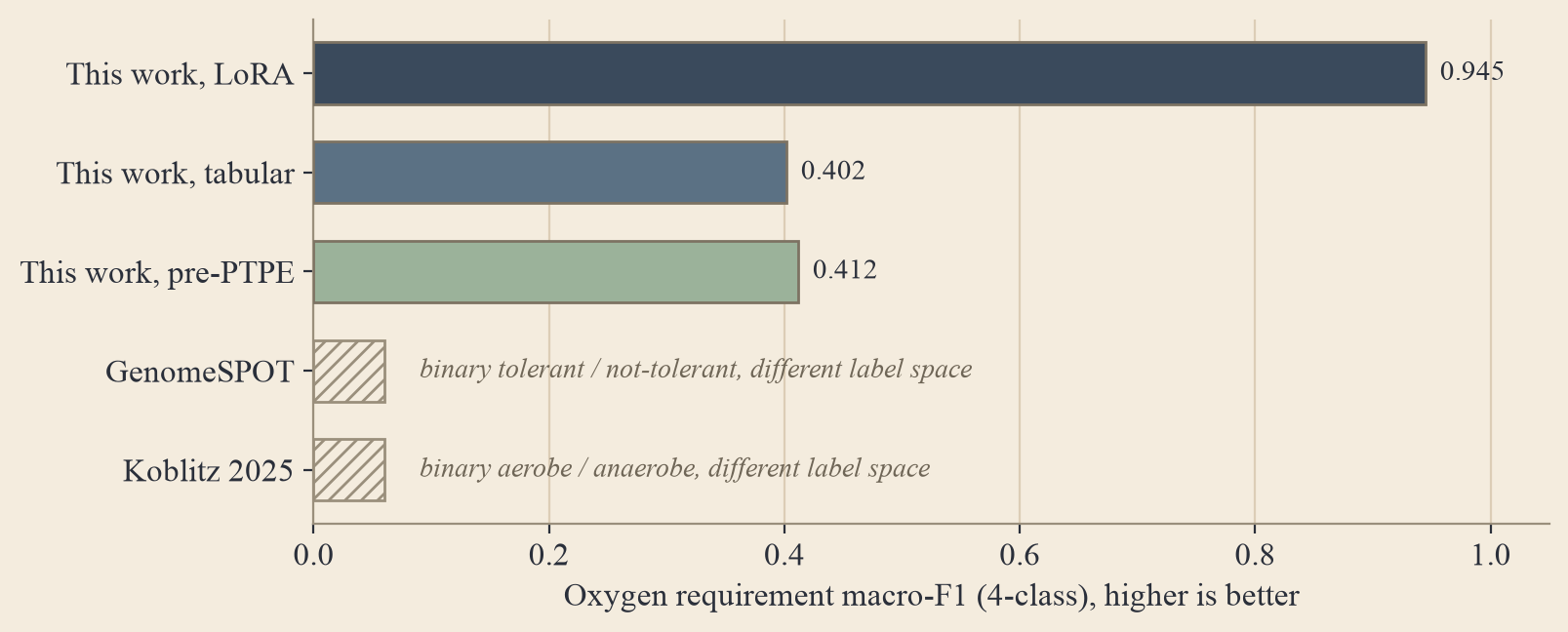
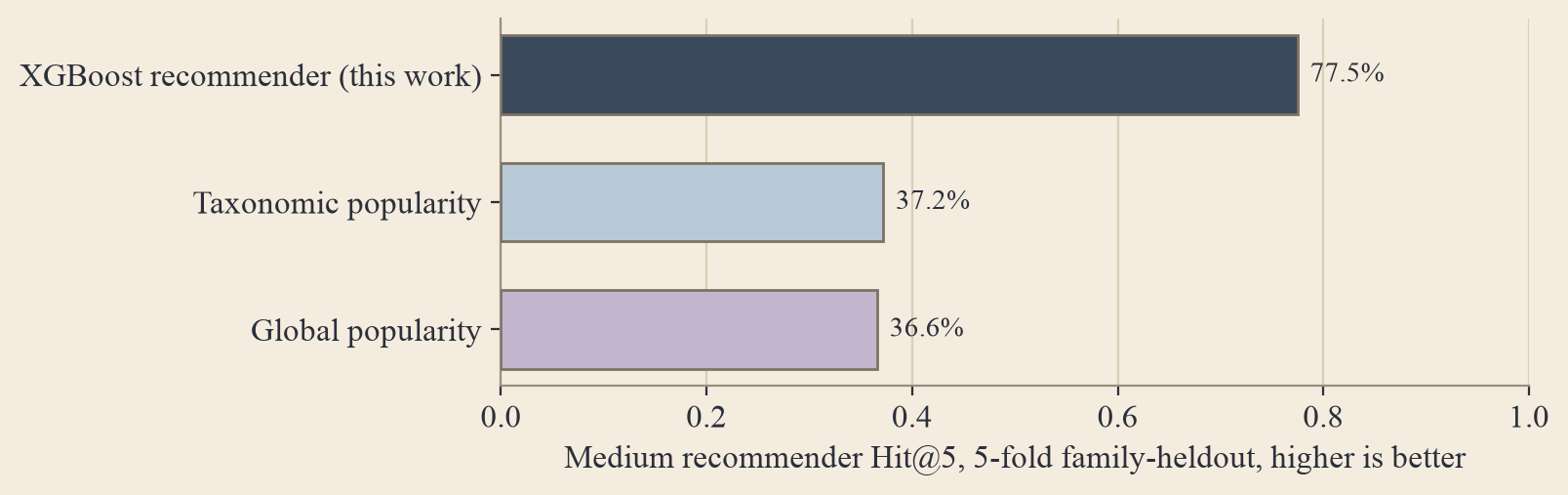
PTPE adds modest, target-dependent lift over the five-path baseline: optimum temperature MAE improves from 2.74 to 2.67 °C (2.4%), salt MAE from 1.94 to 1.92% (1.1%), and pH MAE from 0.473 to 0.469 (1.0%); oxygen macro F1 regresses from 0.412 to 0.402. Against GenomeSPOT on a deterministic 5,000-genome subset, this work is 39% more accurate at temperature, 23% at pH, and 3% at salt. Fine-tuning the protein language model with LoRA adapters on the HMM-gated marker sequences sharply improves oxygen classification (macro F1 0.945 vs. 0.402 for the tabular head). The retained production system is therefore a hybrid: tabular XGBoost for temperature, pH, and salt; all-task LoRA for oxygen; and a tabular MediaDive recommender for medium ranking. Applied to 5,000 GTDB-derived uncultured catalog genomes, it predicts 3,026 aerobes and 1,974 anaerobes.
Keywords: microbial cultivation · phenotype prediction · protein language models · HMM profiles · KEGG modules · BacDive · uncultivated microorganisms
Cite
@article{horiuchi2026hmmgated,
  title   = {HMM-Gated Protein Language Model Embeddings for
             Bacterial Cultivation Condition Prediction},
  author  = {Horiuchi, Miyu},
  year    = {2026},
  note    = {replicater.xyz/writing/hmm-gated-plm-embeddings}
}